Image



*** FOR IMMEDIATE RELEASE ***
Indigenous Women Leaders Hold Critical Conversation on Land and Body Violence
“Land and Body: Indigenous Women’s Defense of Safety and Sovereignty”
United Nations Conference on the Status of Women (UNCSW) Parallel Event
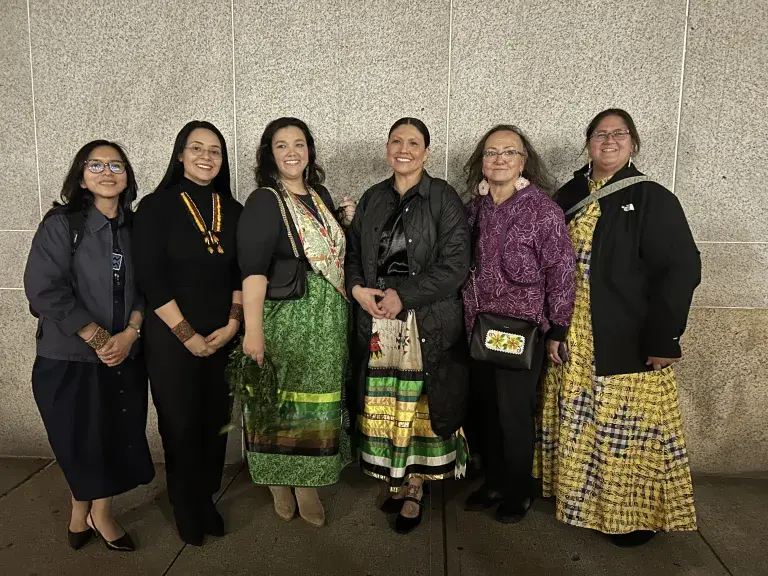
[March 17th, New York, NY] On Wednesday, the Indian Law Resource Center hosted a critical panel discussion on land and body violence at the United Nations Commission on the Status of Women in New York City. The parallel event, entitled, “Land and Body: Indigenous Women’s Defense of Safety and Sovereignty,” explored the intersections of land and body violence that is disproportionately experienced by Indigenous women.
The panel was made up of Indigenous women leaders from Peru, Guatemala, and the United States, including Alaska and Hawaii who discussed needed legal and political protections for Indigenous women impacted by extractive industries. They addressed case studies including the Line 5 pipeline in the United States, the Ambler Road project in Alaska, militarization and nuclearization of Hawaii, rare earth extraction in South Dakota, logging operations in Peru, and the impact of mining in Brazil.
Panelists included Tatewin Means (Attorney), Dolly Tatofi (Interim Executive Director of Pouhana O Nā Wāhine), Lucy Simpson (Executive Director of the National Indigenous Women’s Resource Center), Tami Jerue (Executive Director of the Alaska Native Women’s Resource Center) and three of the Indian Law Resource Center’s own Indigenous staff attorneys: Caroline LaPorte (immediate Descendant of the Little River Band of Ottawa Indians), Gianella Sanchez (Shipibo-Konibo, Peru), and Kari Guajajara (Tentehar, Brazil).
One common thread throughout the conversation was that in all regions discussed, extractive industries are directly perpetuating violence against Indigenous bodies and land. The various harms of extractive industries on Indigenous peoples operate as a self-perpetuating spiral towards further dispossession. Severence from their lands has been particularly devastating for Native women. Caroline LaPorte, Director of the Safe Women, Strong Nations project at the Indian Law Resource Center, explained, “we are frequently reminded through our lived experiences that often the cruelest form of violence is the taking of who you are. And who can we be, if not connected to our land?”
She went on to cite the disproportionate rates of sexual violence, exploitation, and human trafficking leveraged against Indigenous women, particularly in regions where extractive industries are operating on or near Indigenous territories. “When our lands are threatened, our bodies are threatened as well,” explained Gianella Sanchez Guimaraes, staff attorney at the ILRC.
“Violations against the environment lead specifically to other violations against Indigenous women,” said Kari Guajajara, staff attorney with the Indian Law Resource Center. She cited the example of the impacts of mercury contamination on the Yanomani people of the Brazilian Amazon. Linked to illegal gold mining, mercury levels have been found to exceed safety limits by 84% among members of this Indigenous group, affecting women’s ability to become pregnant, poisoning breast milk, and causing birth defects in utero. Guajajara describes this as “a process of silent extermination."
She said, “for us, one of the only answers that exists is the demarcation and protection of Indigenous lands.” Panelists agreed that the future of Indigenous peoples and communities is inextricably linked to the health of the environment.
In closing the event, the IRLC issued a Call to Action, asking attendees to participate in a large-scale community weave called Woven in Place. Participants were given the materials to make their own weaving, depicting a place of significance for them and the ways in which land and body violence may be impacting this place.
LaPorte explained, “Indigenous communities experience diverse and complex injustices, yet resilience, relationship, and stewardship to land remain constant. This collaborative weaving project brings together pieces from around the globe to honor the connection between land, body, safety, and community. It reflects the understanding that violence against land is inseparable from violence against Indigenous peoples.” Submissions for the project will be accepted until October of this year.
###
For more information, contact:
Jenny Eck, [email protected], +1 406 461 1754
For over 40 years, the Indian Law Resource Center has been one of the preeminent nonprofits fighting for Indigenous rights across the Americas. Indigenous led, the ILRC provides assistance to Indian Nations and Indigenous peoples in the United States and throughout the Americas to combat racism and oppression; to protect their lands and environment; to protect their cultures and ways of life; to achieve sustainable economic development and genuine self-government; and to realize their other human rights. More information can be found at: www.indianlaw.org.
CONNECT WITH US: